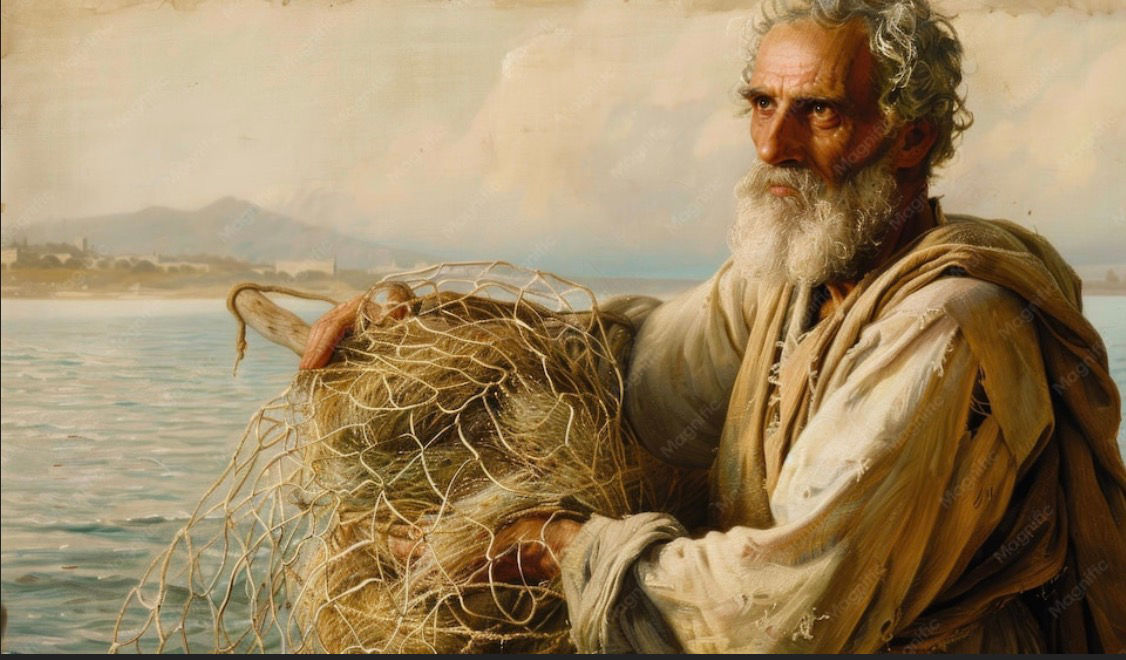
Peter: Ignorant? Liar? Or Inspired?
Peter grew up in Bethsaida on the northeastern shore of the Sea of Galilee. He, along with his brother, Andrew, and his father, were fishermen. We don’t know how much Jewish history and/or law Peter knew, but it seems reasonable to conclude that Peter was not a scholar. However, I have a suspicion that Peter’s father was familiar with Deuteronomy 6:6-9.
We do know that the “rulers and elders and scribes . . . with Annas the high priest and Caiaphas and . . . all who were of the high-priestly family,” Acts 4:5-6, considered the apostles “uneducated and common”, Acts 4:13, meaning they hadn’t been taught anything and they didn’t know anything. So there is a basis for considering that Peter might have been ignorant. These same people were astonished at how well spoken Peter was in Acts 4:13. Nevertheless, they had decided not to believe the things he was saying.
This is not the only time when Peter said something that people chose, and choose, not to believe. In 1 Peter 3:20, he talks about Noah building an ark in which, “eight souls were saved through water.” From Strong’s Exhaustive Concordance, “saved” is past tense of the Greek “diasozo” which means to escape safely, to make perfectly whole, to save. “Through” is the Greek word, “dia” which means on account of, by reason of. In other words (literally) Peter said “eight souls were made perfectly whole by reason of water.”
And then in verse 21 he continues, “which also after a true likeness doth now save you, even baptism, not the putting away of the filth of the flesh, but the interrogation of a good conscience toward God, through the resurrection of Jesus Christ.” From Strong’s again, the phrase “after a true likeness” is from the Greek word “antitupos” which means antitype, and from Thayer’s Greek Lexicon, means a thing resembling another. From the same reference sources the word, “interrogation,” is translated from the Greek, “eperotema,” which means an inquiry, or an earnest seeking. Finally, the word “saves” connected to baptism is “sozo” from the same root as diasozo. Sozo simply means ‘saves.’
In summary, what Peter is saying in 1 Peter 3:20-21 is “eight souls were made whole, i.e. saved, by water. Baptism resembles that, in fact is an antitype of that type, in the way that water saves you in baptism. There is nothing physically about the water that is magic or cleansing. What saves you through baptism is an answering to God, born of your faith and trust in Him, with a good conscience in performing His will. But beyond all of that, all of this depends totally on the resurrection of Jesus Christ, without which there is no salvation.”
It is incorrect to say that baptism is a work. Baptism is explicitly taught in the Bible as something we must do. Baptism is never taught in the Bible as a work whereby we earn salvation separate and apart from the blood of Christ. This whole issue is from the reformation period, see the Trying to Walk article, “Where the Reformation Went Wrong,” June 16, 2026.
Baptism is an act of obedience whereby we connect with the blood of Christ. I don’t know anybody that believes or teaches that baptism is a work by which one earns salvation outside of the grace of God.
I do know of a man who believes and teaches that it is in the obedience of baptism that one comes in contact with the blood of Christ. That man is the apostle, Paul. The blood of Christ, simply because it was shed, does not and will not save anybody. If it did, Heaven would be filled with the most degenerate of ungodly people that ever lived, because everyone would be there. But many verses tell us that is not true, Gal 5:19-21, Rev 21:8, and others.
Paul writes to us in Col. 2:12-13, “having been buried with Him in baptism, wherein ye were also raised with Him through faith in the powerful working of God, who raised him from the dead, and you who were dead in your trespasses and the uncircumcision of your flesh, you, I say, did He make alive together with Him, having forgiven us all our trespasses.” We have to seek forgiveness in order to receive the results of forgiveness. We have to have the answer of a good conscience toward God, an earnest seeking to be right before Him, if we want Christ’s death, burial, and resurrection to be of value to us.
Paul talks about being buried with Him. He talks about being raised with Him. It is only then that he talks about being made alive together with Him. Where do we find such uniting with Christ? In the entire Bible, it is only in baptism.
Baptism is not our work outside the grace of God. If it is a work, it is a work of God. Notice Paul saying in Col, 2:12 “we were raised with Him through faith in the powerful working of God.”
For us, baptism is an act of obedience that unites us with the grace of God. (Christ shedding His blood on the cross for the forgiveness of our sins is the Bible definition of the grace of God. See Trying to Walk article, “Understanding Grace,” May 18, 2026.) Without baptism we can’t have the answer of a good conscience toward God, because we haven’t cooperated with what he wants us to do. Another word for that is rebellion.
Paul preaches the same gospel in Romans 6. Look at the connections we make with the death, burial and resurrection of Christ through baptism as Paul explains in verses 3-4: “Or are ye ignorant that all we who were baptized into Christ Jesus were baptized into His death? We were buried therefore with him through baptism into death: that like as Christ was raised from the dead through the glory of the Father, so we also might walk in newness of life.”
In verse 17 he talks of how we used to be servants of sin, thus under its influence, besieged with its guilt. But something happened. We “obeyed from the heart that form of teaching.” The result of that obedience is “being made free from sin.” The form is the death, burial and resurrection he spoke mightily about in the first part of the chapter. How did we “obey” the form? Paul makes it clear that baptism is a symbolic reenactment of the death, burial, and resurrection of Christ. Baptism is “obey[ing] from the heart that form.” First we are baptized. Then we are free from sin. These are Paul’s inspired words.
The words and phrasing may be different in Romans 6, but Paul’s statement is in complete agreement with what Peter said in 1 Peter 3:20-21. Yes, it was the blood of Jesus Christ that did the work for you. But you united with that blood, that grace, and enabled a clean conscience, when you were baptized.
So was Peter ignorant? He never “sat at the feet of Gamaliel” as Paul did, but he spent three years with Jesus. Can we even imagine how much a person could learn during a three year daily walk with Jesus?
Was Peter a liar? Jesus gave him the “keys to the kingdom” (Matt. 16:18) and told him the things he bound on earth would be the things that were bound in Heaven (Matt. 16:19.) I trust Jesus’ judgment to be better than to give that charge to a liar.
Was Peter inspired? Again, Jesus confirmed that Peter would teach what was the will of Heaven. Peter also confirmed that “no prophecy came by the will of man: but men spake from God, being moved by the Holy Spirit.” 2 Pet. 1:21. Peter was neither ignorant, nor a liar. He wrote as inspired by the Holy Spirit. And he wrote that “baptism doth also now save us.” My prayer is that understanding how that works, we accept it as “the gospel truth” that it is.


I suppose if you don't believe that the Bible is the Word of God and His writers weren't inspired, it would be easy to say that Peter was ignorant and/or a liar.
As a firm believer that the Word has been with us from the beginning, I have no doubt at all that the written word that we're blessed to many copies in hand, is indeed truth and Peter was inspired.